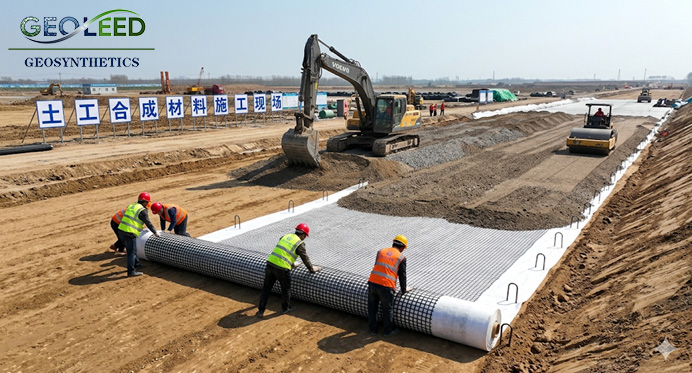
When you combine Geotextiles with Plastic Geogrids (typically made of High-Density Polyethylene – HDPE or Polypropylene – PP), you create a high-strength Reinforcement Geocomposite.
Unlike the fiberglass composite we discussed earlier (which is primarily for asphalt), the plastic geogrid composite is the “heavy lifter” for soil stabilization and earthworks.
The Synergy: Separation + Structural Strength
In this pairing, the two materials solve the “Soft Soil Paradox”:
The Plastic Geogrid (The Skeleton): Provides high tensile strength and interlock. The soil particles get “locked” into the grid apertures, preventing lateral movement.
The Geotextile (The Filter/Skin): Prevents the fine soil (mud) from piping through the grid holes, which would otherwise lubricate the aggregate and cause the structure to fail.
Core Applications
1.Soft Foundation Stabilization (软土地基加固)
Used in road construction over swamps, wetlands, or soft clay.
Application: It is laid directly on the soft subgrade before the gravel base is added.
Benefit: It creates a “Bridging Effect,” allowing heavy construction equipment to drive over soil that would otherwise be too weak to support them.
2.Steep Slopes and Retaining Walls (陡坡与加筋土挡墙)
When building a vertical or very steep slope, soil naturally wants to slide down.
Application: Layers of the composite are buried horizontally within the compacted soil.
Benefit: The plastic grid holds the soil together (like rebar in concrete), while the geotextile ensures internal drainage so that water pressure doesn’t blow out the wall.
3.Paved and Unpaved Roads (有路面与临时道路)
For heavy-duty haul roads (mining, oil rigs) or permanent highways.
Application: Placed between the subgrade and the base course.
Benefit: It reduces the required thickness of the expensive gravel layer by up to 30-40%, saving significant material costs.
4.Landfill Base Reinforcement
In large-scale landfills, the weight of the waste can cause the foundation to settle unevenly.
Application: Placed at the very bottom of the liner system.
Benefit: It protects the environment by ensuring the protective liners don’t tear due to differential settlement of the ground.
Plastic vs. Fiberglass Composites
| Feature | Plastic Geogrid Composite | Fiberglass Geogrid Composite |
| Main Material | HDPE / Polypropylene (PP) | Glass Fiber + Bitumen Coating |
| Primary Use | Soil / Earthwork | Asphalt / Pavement |
| Connection Type | Mechanical Interlock (Soil) | Chemical/Thermal Bond (Asphalt) |
| Corrosion Res. | Extremely High (Acid/Alkali) | High (but sensitive to high pH) |
| Flexibility | High (follows ground contours) | Low (Stiff, high modulus) |
Installation Tips
Tensioning: The composite must be pulled taut before pinning it to the ground. If there is slack, the reinforcement won’t “activate” until the road has already started to sink.
Overlap: Typically requires a 300mm to 500mm overlap at the edges. In very soft soil, these overlaps may need to be cable-tied together.
Damage Control: Avoid driving heavy tracked vehicles (like bulldozers) directly on the material before at least 15-20cm of soil has been spread over it.