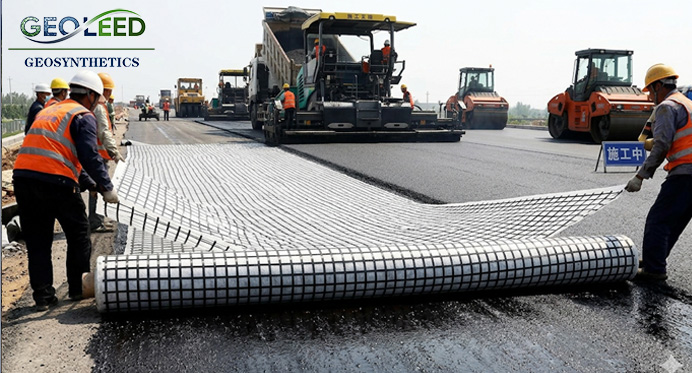
When you combine Geotextiles (土工布) with Fiberglass Geogrids (玻纤土工格栅), you create a high-performance “composite” material that tackles both hydraulic and structural issues simultaneously.
In the industry, this is often referred to as a Geotextile-Geogrid Composite (复合土工格栅) or Bitumen-coated Fiberglass Geocomposite.
Why Combine Them? (The Synergy)
While they are great individually, they have different “superpowers”:
Geotextile: Excellent at sealing,filtering, and providing a uniform surface, but has high elasticity (it stretches too much under heavy loads).
Fiberglass Geogrid: Incredible tensile strength and low elongation (it doesn’t stretch), but it’s a grid with holes—it can’t stop water or fine particles on its own.
The Result: A material that reinforces the ground while providing a waterproof or filtration barrier.
Major Applications
1.Asphalt Pavement Overlays (道路拓宽与旧路改造)
This is the most common use. When an old concrete road is covered with new asphalt, “reflective cracking” usually happens (cracks from the old road telegraph up to the new one).
The Role: The geotextile absorbs bitumen (asphalt oil) to form a waterproof membrane, while the fiberglass grid
reinforces the asphalt layer to resist cracking and rutting.
Benefit: Extends the life of the road by 2–3 times.
2.Soft Soil Foundation Improvement (软土地基处理)
In areas with “muck” or soft clay (like riverbanks or coastal roads), using just a grid might allow the mud to squeeze through the apertures.
The Role: The geotextile acts as a separator (keeping the sand/stone layer clean from mud), while the fiberglass grid provides the “tensile platform” to support the weight of the embankment.
3.Airport Runways and Taxiways
Runways face extreme “shear forces” from landing aircraft.
The Role: The composite material provides high-modulus reinforcement. The fiberglass handles the high stress of heavy jets, while the geotextile ensures the bond between pavement layers is moisture-proof.
Performance Comparison
| Feature | Geotextile Only | Fiberglass Grid Only | Combined Composite |
| Tensile Strength | Low to Medium | Very High | Very High |
| Waterproofing | Good (when saturated) | None (Open grid) | Excellent |
| Separation | Excellent | Poor | Excellent |
| Anti-Cracking | Moderate | High | Superior |
Installation Highlights
Surface Prep: The road must be clean and dry.
Tack Coat: For roadwork, a bitumen emulsion (tack coat) is sprayed first. The geotextile part of the composite “soaks” this up to create a permanent bond.
Tensioning: The grid must be laid flat without wrinkles. Since fiberglass is brittle if folded sharply, professional mechanical layout is preferred.
Overlapping: Usually, a 10–15 cm overlap is required at the joints to ensure continuous reinforcement.