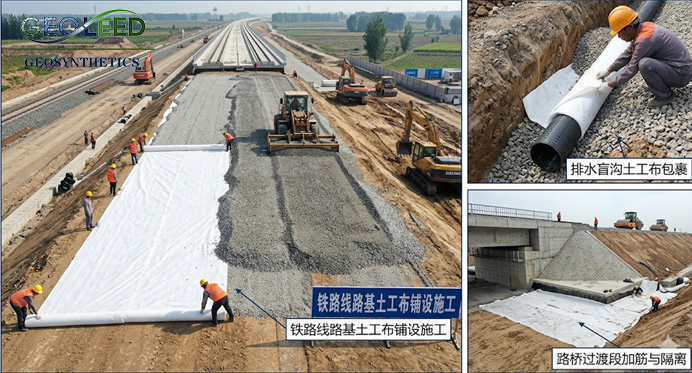
In railway engineering, Geotextiles (particularly continuous filament non-woven types) act as a multi-functional “separator” and “stabilizer.” Whether for high-speed passenger lines or heavy-haul freight tracks, they are essential for maintaining the structural integrity of the track bed.
Core Applications in Railways
1.Separation of Ballast and Subgrade (The Most Vital Use)
The biggest threat to a railway is “ballast fouling.”
This happens when the soft subgrade soil (mud) pumps upward into the clean ballast, or when the heavy ballast stones are pushed down into the soft soil.
The Fix: A geotextile layer acts as a permanent barrier. It keeps the heavy stone ballast separate from the fine soil, maintaining the load-bearing capacity of the track.
2.Filtration and Drainage
Water is the enemy of any railway. Geotextiles allow water to drain laterally and vertically out of the track structure while keeping fine soil particles in place.
The Fix: By preventing the buildup of pore water pressure, the geotextile prevents
“pumping”
(where the passing of a train forces mud up through the ballast, leading to track instability).
3.Reinforcement and Load Distribution
In areas with soft or weak ground (like marshlands or clay), geotextiles (or composite geogrids) provide tensile strength.
The Fix: They help distribute the massive weight of the train more evenly across the subgrade, reducing the risk of localized settlement or “ruts” in the track.
Comparison: Ballasted vs. Ballastless Tracks
| Feature | Ballasted Track (有砟轨道) | Ballastless Track (无砟轨道) |
| Location | Between ballast and subgrade. | Under the concrete base/slab. |
| Primary Role | Preventing mud pumping/fouling. | Drainage and sliding layer protection. |
| Material Choice | Heavy-duty non-woven (high puncture resistance). | High-strength non-woven or sliding layers (for thermal expansion). |
Technical Advantages in Rail Projects
Vibration Damping: The fabric provides a minor but significant cushioning effect, absorbing some of the high-frequency vibrations from high-speed trains.
Longevity: Railways are designed for 50–100 year lifespans. Continuous filament geotextiles are highly resistant to biological degradation and the alkaline environment of concrete.
Cost-Efficiency: It is much cheaper to install a geotextile layer than to constantly “clean” the ballast (a process called ballast undercutting) every few years.
Professional Terms to Know (Railway Context)
Subgrade (路基): The foundation soil.
Ballast (道砟): The crushed stones that support the ties.
Fouling (污秽/冒泥): When fine soil ruins the drainage of the stone ballast.
Pumping (翻浆冒泥): The “squishing” effect where water and mud are forced upward by train pressure.
Sub-ballast (底砟): The transition layer between ballast and soil.