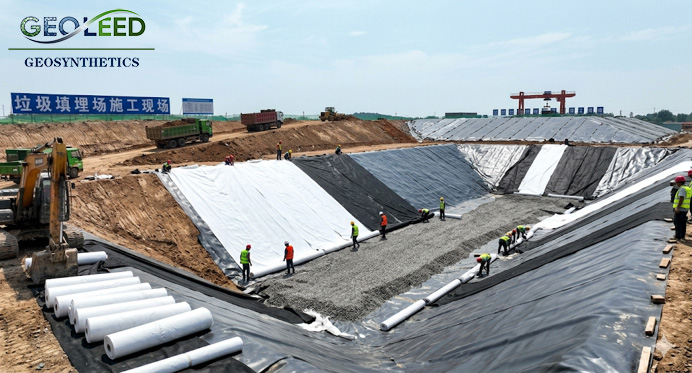
In the context of waste management engineering, Continuous Filament Non-woven Geotextiles (often made of high-quality polyester or polypropylene) serve as the “biological and mechanical shield” of a landfill.
Here is the breakdown of their applications in English:
Key Functions in Landfills
1.Protection (Cushioning)
This is the most critical role. The geotextile acts as a heavy-duty buffer to protect the HDPE Geomembrane
(the primary liner) from being punctured by sharp objects in the waste or the coarse drainage gravel.
Mechanism: It absorbs localized stresses and prevents “point loading.”
2.Filtration
Placed between the waste and the leachate collection system, it acts as a filter.
Mechanism: It allows leachate(liquid waste) to pass through into the pipes while blocking soil and waste particles, preventing the drainage system from clogging (silting).
3.Separation
It prevents the intermixing of different layers, such as the drainage aggregate and the overlying protective soil or waste.
Mechanism: Maintains the integrity and hydraulic performance of each functional layer.
Typical Layer Configuration (Bottom to Top)
| Layer | Material | Function |
| Foundation | Compacted Clay | Base support |
| Protection | Filtration Geotextile | Protects the secondary liner |
| Primary Liner | HDPE Geomembrane | Main seepage barrier |
| Cushion | Continuous Filament Geotextile | Protects membrane from gravel |
| Drainage | Gravel / Geonet | Collects leachate |
| Filter | Continuous Filament Geotextile | Prevents clogging of drainage layer |
Why Continuous Filament vs. Staple Fiber?
In landfill engineering, Continuous Filament(long fiber) is preferred over Staple Fiber(short fiber) for several reasons:
Higher Tensile Strength: Better resistance to the massive pulling forces caused by waste settlement.
Superior Puncture Resistance: Essential for protecting the geomembrane under high pressure.
Creep Resistance: It maintains its thickness and structure much better over the 30–50 year lifespan of a landfill.
Chemical Stability: Better resistance to the harsh, acidic, or alkaline environment of landfill leachate.